

On 15 June, the Catalan Government (Generalitat), employers’ associations Foment del Treball and PIMEC, and trade unions CCOO and UGT signed the new National Pact for Industry 2026-2030 (PNI). This is the third pact of its kind, following the PNI 2017-2020 and 2022-2025, and it sets Catalonia’s industrial strategy for the next five years.
The Pact includes:
- 190 measures (155 horizontal and 35 sector-specific).
- An initial budget of €4.463 billion.
- A commitment to reach at least €5 billion, depending on how the budget evolves.
All of this is structured around three main pillars aligned with the European recommendations set out in the Draghi and Letta reports: productivity, decarbonisation and sustainability, and resilience.
Why is this new Pact necessary?
The context explains the urgency. Industry remains one of Catalonia’s main economic engines, but it has lost ground over recent decades.
According to PIMEC’s remarks at the signing ceremony, Catalonia has lost around 14,000 industrial businesses and 145,000 jobs in the sector since 2000, with industry’s share of the economy falling from 28% to around 19%. Foment del Treball voiced its aspiration for industry to reach 25% of Catalan GDP.
Industrial estates: a strategic asset of the first order
One of the most significant new features of the PNI is the weight it gives to industrial land. The Pact devotes one of its five main areas of action specifically to infrastructure and industrial land, alongside sustainability and energy, quality employment, innovation and competitiveness, and the institutional and social framework.
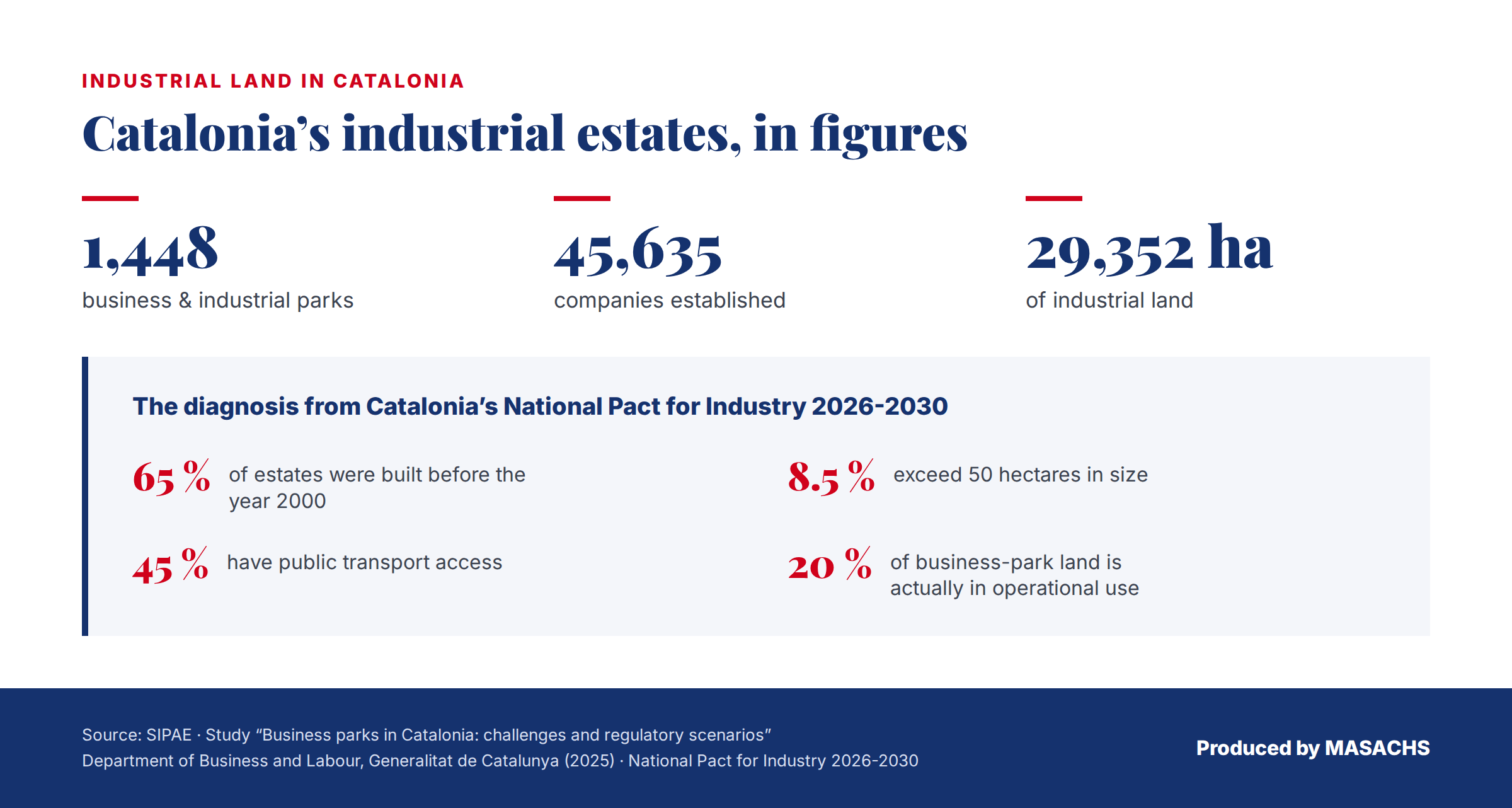
And this is no coincidence: according to the Business and Industrial Parks Information System (SIPAE), Catalonia has a network of 1,448 business and industrial parks, home to 45,635 companies across 29,352 hectares of land. It is, quite literally, the physical backbone of the country’s industry: the place where much of what the Catalan economy produces is manufactured, stored and distributed.
An honest diagnosis: ageing, fragmented and scarce land
The value of the PNI lies not just in its budget, but in the fact that it sets out in black and white the shortcomings of Catalonia’s industrial estates. The diagnosis, drawn from the study “Business parks in Catalonia: challenges and regulatory scenarios” by the Department of Business and Labour, points to four structural weaknesses that any business that has looked for a unit or plot in recent years will recognise straight away:
- Ageing infrastructure. Two out of three estates (65%) were developed before 2000, with services, utilities and urban planning designed for the industry of another era.
- Fragmentation. Only 8.5% of estates exceed 50 hectares. The vast majority are small sites, with little capacity to host large-scale industrial projects or fund shared services.
- Limited connectivity. Fewer than half (45%) have public transport access, a real barrier to attracting and retaining workers in a tight labour market.
- Genuine land shortage. Perhaps the most telling figure: only 20% of land zoned for economic activity is actually in operational use. On paper, there is plenty of land; in practice, land that is available, serviced and ready for immediate occupation is in short supply.
This last figure explains a paradox we see every day in the market: thousands of zoned hectares coexist with a genuinely tight supply of units and plots in the areas of highest demand, particularly in the Barcelona metropolitan area and along the main logistics corridors.
Deciding on the industrial model means deciding on the model for the country: how the territory is structured, what opportunities are created, and what jobs are wanted. Industrial land is a central piece of that equation.
What does this mean for businesses looking for industrial premises or land?
From the perspective of anyone who has to decide whether to buy, lease or relocate an industrial activity, the PNI points to some trends worth bearing in mind:
Location will become even more valuable. With genuinely operational land in short supply and modernisation set to concentrate in specific areas, well-located units in established, well-connected estates are likely to see their value rise.
Modernised estates will be more competitive. Investment in energy, digitalisation and public transport will boost the appeal of the estates that benefit from it, both for operating there and for attracting talent. Tracking which areas attract investment will be key to medium-term decisions.
Refurbishing older units makes strategic sense. With two-thirds of the stock built before 2000, upgrading existing assets (energy efficiency, regulatory compliance, solar panels, EV charging) will be one of the major value levers of the coming years, often faster than waiting for new land to become available.
The framework offers continuity. The PNI 2026-2030 provides assurance that Catalan industrial policy will stay the course throughout the period — no small factor for property investments planned over a ten- or fifteen-year horizon.
Our take
At Masachs, we work every day with the industrial land and units that the Pact aims to transform, and the PNI’s diagnosis matches what we see on the ground: demand is solid, but quality product is limited and the estate stock needs renewing. The fact that the country now has a shared roadmap, with a budget and with industrial estates as a central piece, is good news for industrial businesses and for the property market that serves them.
We will be following the rollout of the planned measures closely, along with their impact on the market for industrial units and land. If your business is considering setting up, growing or relocating, we can help you make sense of this new landscape and find the space that best fits your needs.