
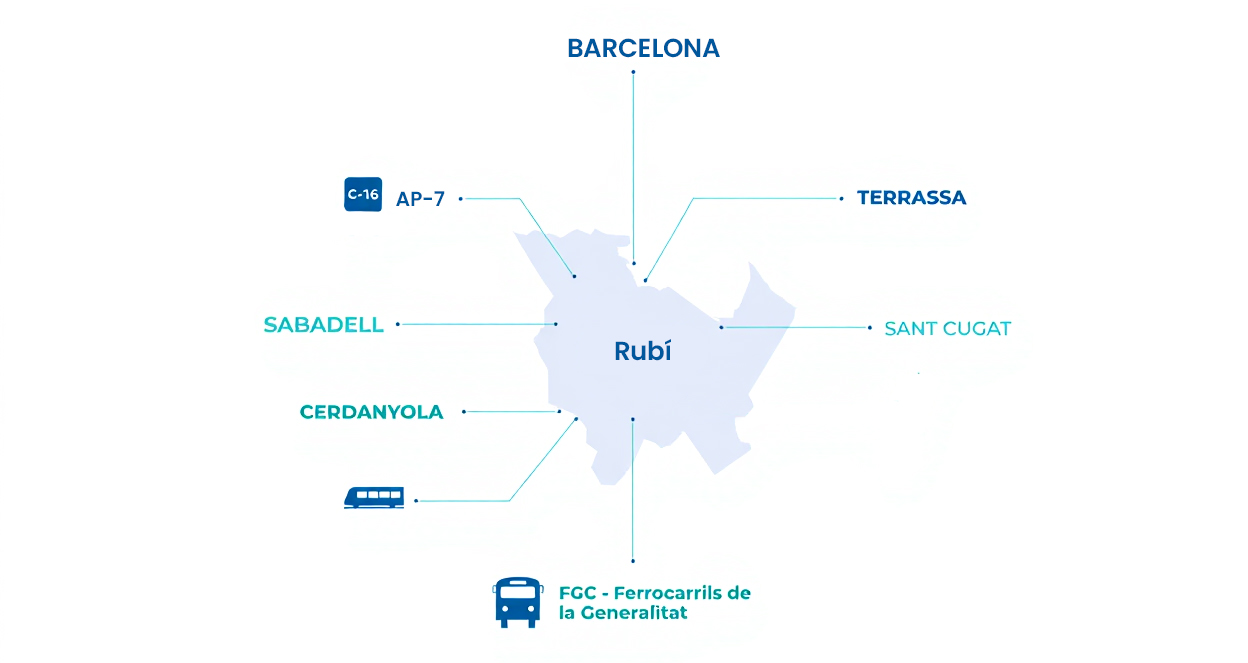
Rubí is, without a doubt, one of the most important industrial cities in Catalonia. Located in the Vallès Occidental area, between the AP-7 and the C-16 motorways, this municipality of nearly 80,000 inhabitants concentrates an unusually high density of economic activity for any territory in southern Europe.
For any company seeking an industrial unit or logistics space in the Barcelona metropolitan area, Rubí represents a prime option: competitive prices, excellent connectivity, a well-established business ecosystem, and the active support of a local administration focused on economic activity.
An industrial vocation that is no coincidence
39.3% of jobs in Rubí are directly linked to the industrial sector — the highest percentage of any municipality in Catalonia. Granollers, second in the Catalan ranking, stands below 20%. This figure illustrates better than any other indicator the city’s economic profile: Rubí is not a commuter suburb of Barcelona, but a self-sufficient economic engine in its own right.
With 10 economic activity zones (industrial estates) covering nearly 400 hectares — 7% of all industrial land in the Vallès Occidental — and more than 600 active companies generating around 15,000 direct jobs, Rubí is an industrial benchmark for the entire metropolitan production network.
Is Rubí a good location for an industrial unit?
What industrial estates are there in Rubí?
| Industrial estate | Unit sizes | Maximum heights | Main access routes | Public transport | Main activity |
|---|---|---|---|---|---|
| Ca n’Alzamora (CIT 1E) |
500–600 m² |
15 m | C-1413a | Bus: L2 and L5 Rubíbus | Property rental, metal treatment, machinery repair |
| Can Jardí (CIT 1B) | 600-2.000 m² | 15 m | AP-7, C-1413a | Train: R8, S1 and S5. Bus: C6 Castellbisbal–Rubí, L6 Rubíbus | Metal treatment, machinery repair, freight transport |
| Can Rosés (CIT 5D) | 500-600 m² | —* | BP-1503, BP-1503a, C-1413a | Train: R8. Bus: L1, L2, L4 and L5 Rubíbus | Graphic arts, machinery and equipment trade |
| Can Sant Joan Oest (CIT 3A) | +2.000 m² | 26 m | AP-7, C-16, BP-1503 | Bus: SJ i B7. Train: R8, S1 and S5 | Electronic cable manufacturing, auditing services |
| Can Vallhonrat (CIT 1A) | +2.000 m² | —* | AP-7, C-1413a | Bus: L2 Rubíbus | Pumps and compressors, hardware, technical activities |
| Cova Solera (CIT 1F) | 600-2.000 m² | 15 m | C-1413a | Train: R8. Bus: L1 and L6 Rubíbus | Construction, graphic arts, technical engineering |
| Ctra. de Terrassa (CIT 5A) | 500-600 m² | 15 m | BP-1503, C-16 (E-09) | Train: R8, S1 and S5. Bus: L6, B8 and N61 | Professional services, catering, ornamental stone |
| La Llana – Can Serra (CIT 5B) | +2.000 m² | 15 m | C-16, BP-1503, C-1413a | Bus: L6 Rubíbus. Train: S1 and S5 | Machinery trade, essential oils manufacturing |
| Molí de la Bastida (CIT 5C) | 600-2.000 m² | 15 m | BP-1503, C-16 (E-09) | Bus: L6 and B8 | Trade intermediaries, printed circuits, vehicle spare parts |
| Rubí Sud (CIT 1D) | +2.000 m² | 15 m | AP-7, C-1413a | Bus: C6 andL6 | Plastics and metal manufacturing, chemical trade |
| * Data not available from the source consulted. Source: Vallès Occidental Chamber of Commerce – Industrial Estates Portal (poligons.ccvoc.cat), consulted in March 2026. | |||||
Which industrial estates in Rubí are the best?
The answer largely depends on the type of activity and the specific needs of each company, but the map makes it fairly clear:
For small units (up to 500–600 m²): The top estates are Can Rosés and Ctra. de Terrassa, where the layout of terraced units and plot sizes provide a plentiful supply of smaller formats, often with good access and reasonable prices. Ca n’Alzamora is a good alternative if you value excellent rail connectivity and ceiling heights of 12–15 m even in small units.
For medium units (600–2,000 m²): Cova Solera and Can Jardí have the largest offering in this segment, with the versatility to accommodate manufacturing, technical workshops, and medium-scale logistics. Molí de la Bastida is ideal for activities requiring direct access to the C-16.
For large or very large units (over 2,000 m²): Can Jardí, Rubí Sud, and Cova Solera are the reference estates, offering the largest plots in the municipality, space for manoeuvring yards, and ceiling heights up to 15 m. For high-demand logistics, Can Vallhonrat is the best option in terms of road accessibility, just 1 km from the main network. For large tertiary uses—offices, laboratories, or even hotels—Can Sant Joan Oest is the only estate with planning that allows heights up to 26 m.
How much does it cost to rent or buy an industrial unit in Rubí?
Industrial unit prices in Rubí have historically remained below those in the more central areas of the Barcelona metropolitan region, despite upward pressure across the Vallès Occidental in recent years.
As a reference, rental prices across the metropolitan area’s counties have ranged between €2 and €4.7/m² per month, with Vallès Occidental in the mid-range. Based on current market listings, indicative prices in Rubí are approximately as follows:
Rent
- Small units (up to 500 m²): €4–7/m² per month, depending on the estate and condition.
- Medium units (500–2,000 m²): €3.5–6/m² per month.
Purchase
The average sale price of an industrial unit in Vallès Occidental is around €690/m². In Rubí, however, there is significant variation: older units in the more established estates can be found below €600/m², while standalone “Type C” units in good condition and prime locations can exceed €1,000/m².
Want to know the value of your Rubí unit?
We can provide a valuation with no obligation.
Why Rubí can be a better option than other towns
Many municipalities in the Vallès Occidental offer industrial land, but Rubí brings together a combination of factors that set it apart:
- A uniquely strong industrial base. Rubí has one of the most significant concentrations of industrial activity in the region, with a considerable share of jobs and enterprises located in its industrial estates. This has helped establish a critical mass of industry that many neighbouring towns don’t match.
- Excellent connectivity. Rubí’s location between the AP‑7 and C‑16 motorways gives it superior road links compared with municipalities that only have access to a single major route. This makes logistics and distribution easier and more reliable, a major advantage for industrial and logistics companies.
- Mature business ecosystem. Because Rubí has a long industrial tradition and a dense network of firms, suppliers, service providers and customers are already established locally. This creates spill‑over benefits — companies benefit from proximity to partners and skilled workers, rather than having to build those connections from scratch, as they might in less industrial towns.
- Strong institutional support. Local business support structures in Rubí work actively with companies to help them navigate regulations, access resources and settle in more smoothly than they might elsewhere. The city is also part of broader industrial competitiveness initiatives across the Vallès Occidental, reinforcing its position in regional development strategies.
- Competitive prices without sacrificing quality. While some nearby areas (e.g. closer to central Barcelona or higher‑end suburbs) may charge higher rents or land prices, Rubí offers a more balanced cost‑quality equation alongside strong connectivity and access to labour — something less industrialised or more peripheral towns can struggle to match.
What industrial sectors exist in Rubí?
Rubí’s industrial fabric spans a wide range of sectors, with particularly strong representation in:
- Chemical, pharmaceutical and rubber industries
- Metallurgy and mechanical component manufacturing
- Industrial machinery production
- Electrical and electronic equipment
- Transport, logistics and storage
- Information and communication technologies (ICT)
- Various manufacturing and consumer products
This sectoral diversity offers two key advantages: on one hand, stability and resilience against isolated sector-specific crises; on the other, a business ecosystem where companies of different types can easily find suppliers, clients, and partners within a very short radius.
A thriving business environment
Active support from the local administration
The Rubí City Council has established Rubí Empresa, a municipal structure dedicated entirely to supporting businesses and entrepreneurs.
This institutional focus on serving the local economic fabric is a key differentiator, greatly facilitating company setup and growth by reducing bureaucratic hurdles and the time required to start operations.
Interested in exploring Rubí’s industrial park? Take a look at the available industrial units.
Sources and references
- Rubí City Council, particularly the Rubí Economic Activity Zones Plan (PDF)
- Consortium for Employment and Economic Promotion of Vallès Occidental – periodic reports on industrial land and units (availability, prices, and distribution by municipality)
- Industrial Estates Directory, Vallès Occidental County Council
- Idescat – Statistical Institute of Catalonia: Rubí in figures (GDP, GVA by sector, population, area)
- Cartographic and Geological Institute of Catalonia (ICGC) – Georeferenced database of Catalonia’s industrial estates, Economic Activity Zone Information System (SIPAE)
Frequently Asked Questions
How much does it cost to rent an industrial unit in Rubí?
According to data gathered by Masachs Industrial, the guide price for renting an industrial unit in Rubí is between €4 and €7/m²/month for small units of up to 500 m², and between €3.50 and €6/m²/month for units between 500 and 2,000 m². The price can vary depending on the industrial estate, the condition of the property and its features.
Not sure how much your unit is worth? Get in touch.
What advantages does Rubí offer over other industrial areas in Vallès Occidental?
At Masachs Industrial, we believe Rubí is one of the most well-rounded industrial locations in Vallès Occidental, particularly thanks to its combination of connectivity, variety of industrial estates, range of unit sizes and competitive prices. There is no single estate that suits every business. The choice depends mainly on the floor area required, the type of activity, the access needed and the characteristics of the unit.
Based on our experience in the industrial market:
- For small units of up to 500–600 m², Can Rosés and Carretera de Terrassa stand out.
- For units between 600 and 2,000 m², Cova Solera and Can Jardí offer a particularly versatile range.
- For businesses needing more than 2,000 m², Can Jardí, Rubí Sud and Cova Solera are the standout choices.
- For activities where road and logistics connectivity are a priority, Can Vallhonrat enjoys a particularly favourable location.
For this reason, before choosing a unit in Rubí, we recommend assessing not only the price per square metre, but also aspects such as access for lorries and trailers, clear height, yards, electrical capacity, fire safety regulations and proximity to the main transport routes.
At Masachs Industrial, we can help you work out which area and which type of unit best suit your company’s needs.
Are there industrial units in Rubí with access to public transport?
Yes. Several industrial estates in Rubí have connections via Rubíbus, intercity buses, FGC and the R8 Rodalies line, depending on the area.
Rubí also has a direct connection to Barcelona via FGC, as well as bus connections to towns such as Terrassa, Sabadell, Sant Cugat and Cerdanyola.
How do I sell my industrial unit in Rubí?
Although there are guide selling prices for Rubí and Vallès Occidental, the value of an industrial unit can vary considerably depending on factors such as location, floor area, condition, type, access, yards, facilities and construction features.
At Masachs Industrial, we offer personalised, no-obligation advice to accurately value your unit.
Whether you’re a business, an owner or an investor, if you need to make a decision about an industrial unit in Rubí, it’s advisable to have up-to-date market information and specialist advice.