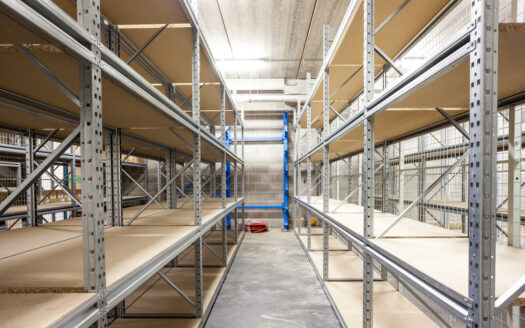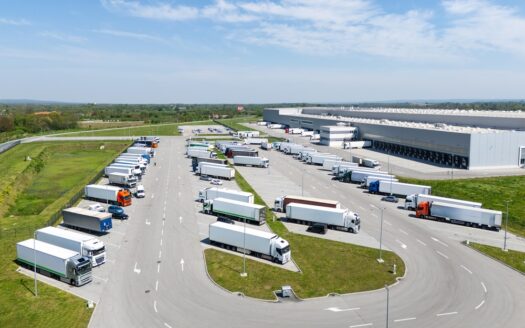


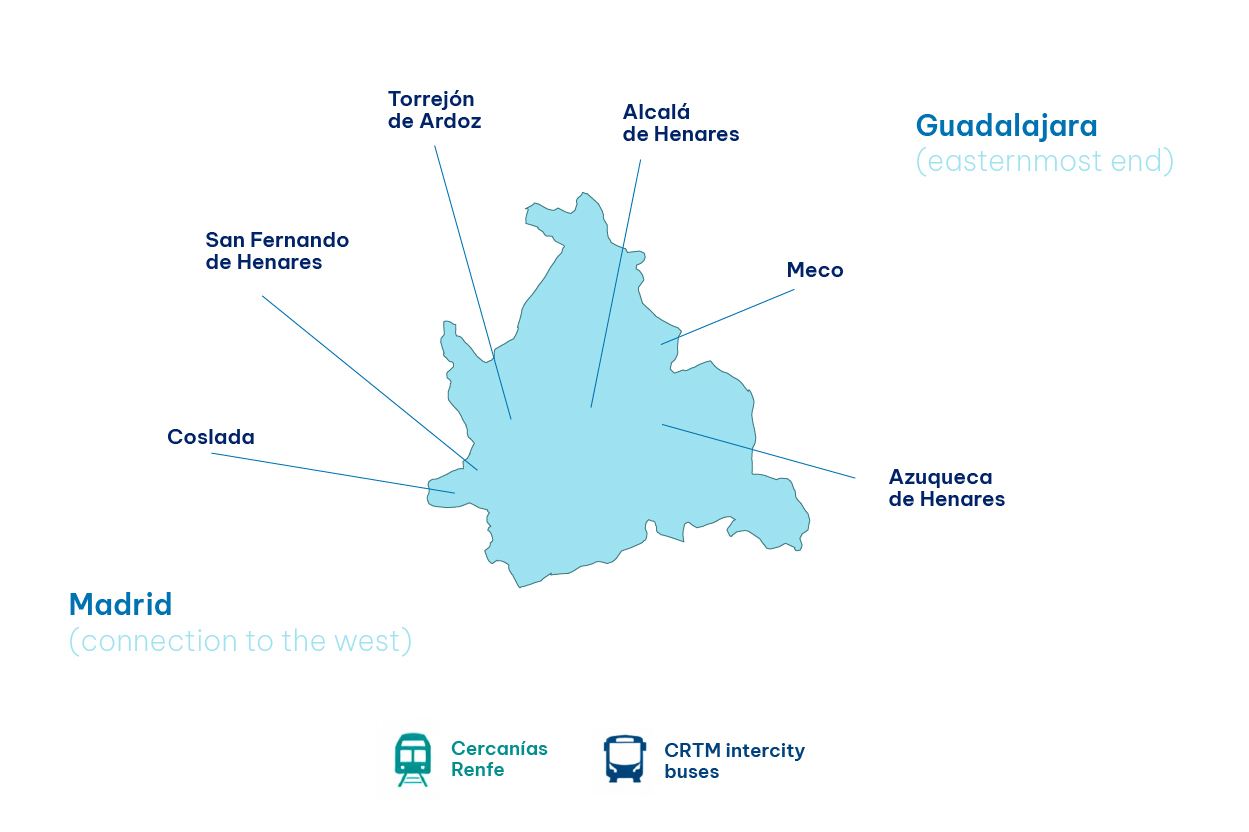
The Henares Corridor is the major industrial and logistics artery linking Madrid with Castilla-La Mancha along the course of the River Henares. It is a territorial unit some 50 km long that stretches across the east of the Community of Madrid and into the province of Guadalajara, connecting municipalities as varied in size as Coslada, San Fernando de Henares, Torrejón de Ardoz, Alcalá de Henares, Azuqueca de Henares, Alovera, Cabanillas del Campo, Marchamalo and the provincial capital, Guadalajara, itself. Few areas in Spain concentrate so much logistics activity per square metre of available land.
An industrial axis that took off more than three decades ago
Industrial estates became widespread in Spain in the late 1970s, as companies left central Madrid behind owing to a lack of available land. Coslada was the first major municipality on the Madrid side to join this movement: the company Centro de Transportes de Coslada was set up in 1989 with the participation of IMADE and, from the early 1990s, became the logistics seed of the entire corridor. Since then, the axis has continued to expand.
Today the corridor covers 17 municipalities in its Madrid section alone. According to official figures, 2,000 companies already operate in the Henares Corridor, more than 400 of them foreign-owned. The 2026–2030 Industrial Plan will mobilise more than €640 million across 76 initiatives spread over seven priority sectors: biopharma, automotive, data centres, artificial intelligence, semiconductors, aerospace and defence.
Its real strength: sitting between Madrid and the motorway to Europe
No other Spanish corridor so naturally combines proximity to the capital, direct access to the country’s main airport, Adolfo Suárez Madrid-Barajas, and an outlet to the north-east of the peninsula.
By road, the backbone is the A-2 (North-East Motorway), which connects Madrid with Guadalajara, Zaragoza and, ultimately, Barcelona. Running parallel is the R-2, the toll radial road that relieves heavy goods traffic, while the M-50, M-45 and M-100 allow movement between the different estates without having to enter central Madrid.
By rail, the corridor is served by the C-2, C-7 and C-8 lines of Cercanías Madrid, which connect Coslada, San Fernando de Henares, Torrejón de Ardoz and Alcalá de Henares with the centre of the capital, with the C-2 also reaching Azuqueca, Meco and Guadalajara.
On top of this comes an asset that few industrial areas in Spain can offer: proximity to Adolfo Suárez Madrid-Barajas Airport, just minutes from the estates in Coslada, San Fernando and Torrejón de Ardoz, which makes this axis a preferred destination for operators with air freight requirements.
The corridor’s industrial estates, municipality by municipality
The Henares Corridor is not a single industrial park, but a succession of estates strung along the A-2, each with its own specialisation:
| Municipality | Province | Main estates | Dominant profile |
|---|---|---|---|
| Alcalá de Henares | Madrid | La Garena · Camporroso | Large logistics platforms |
| Alovera | Guadalajara | Los Picones | High-volume logistics |
| Azuqueca de Henares | Guadalajara | Polígono Miralcampo | Automotive, agri-food |
| Cabanillas del Campo | Guadalajara | Cantos Blancos · La Quinta · SI-20 · SI-21 | From workshops and SMEs to large Big Box logistics |
| Coslada | Madrid | Centro de Transportes de Coslada (CTC) | Freight transport, cross-docking, last mile |
| Guadalajara | Guadalajara | El Ruiseñor | New large-scale logistics developments |
| Marchamalo / Guadalajara | Guadalajara | Ciudad del Transporte | Large public logistics estate under expansion |
| Meco | Madrid | Polígono Neinor | Medium-sized industry and storage |
| San Fernando de Henares | Madrid | Puerta de Madrid · Las Fronteras · Parque Empresarial San Fernando | Large-format logistics and diverse industry |
| Torija | Guadalajara | Polígono Industrial de Torija | Third ring, large-floorplate warehouses |
| Torrejón de Ardoz | Madrid | Los Almendros · Las Monjas · Casablanca | High-volume logistics and fashion |
Which area best suits the location you’re looking for your company’s warehouse?
First ring (Coslada, San Fernando de Henares, Torrejón de Ardoz)
This is the section closest to Madrid and the airport, with the highest density of logistics operators in the corridor. Ideal for last-mile distribution or parcel companies that need to be near the capital, although prices are the most stretched in the area.
Second ring (Alcalá de Henares, Meco)
It combines good connectivity with somewhat more land availability. It is the sweet spot for medium-sized industrial companies that no longer fit in the first ring but want to stay within easy reach of Madrid.
Third ring (Azuqueca de Henares, Alovera, Cabanillas del Campo, Guadalajara, Marchamalo, Torija)
This is where the largest logistics developments are concentrated: turnkey warehouses of more than 30,000 m² signed by operators such as Obramat and Cainiao. It is the area with the best price-to-floor-space ratio for large-format facilities.
Looking for an industrial warehouse in the Henares Corridor?
Rental and sale prices in the Henares Corridor
Rental
- First ring (Coslada, San Fernando, Torrejón de Ardoz): €6–9/m²/month
- Second ring (Alcalá de Henares, Meco): €4.5–6.5/m²/month
- Third ring, province of Guadalajara (Azuqueca, Alovera, Cabanillas, Marchamalo): €3–5/m²/month
Sale
- Warehouses on established estates (Azuqueca, Guadalajara, Cabanillas): €450–600/m²
- New or recently built quality warehouse: from €700–800/m²
- Older warehouse on a long-standing third-ring estate: from €300/m²
Would you like to know what your warehouse in the Henares Corridor is worth?
We’ll give you a free, no-obligation valuation
Why the Henares Corridor could be the best choice for your company
The crossroads between Madrid and Europe
No other industrial area in Spain simultaneously combines a direct motorway to Madrid, a parallel toll radial road, three Cercanías lines and immediate proximity to Barajas Airport. For a company with national or European distribution, it is hard to find a better balance between land cost and speed of access to market.
A mature and expanding industrial ecosystem
With more than three decades of history since Centro de Transportes de Coslada was set up, the corridor has attracted leading manufacturers such as Mercedes-Benz, BMW, Mahou-San Miguel, Inditex and Bimbo, which in turn bring with them a network of suppliers, workshops and ancillary logistics operators rarely found outside large metropolitan areas. The 2,000 companies operating in the corridor today, 400 of them foreign-owned, confirm that the business fabric is still growing.
Room to grow in the third ring
While the first ring is starting to show signs of saturation, the corridor’s Guadalajara municipalities continue to deliver new land: turnkey projects in Azuqueca, Alovera and Torija show that there is still space for large-format warehouses, something increasingly scarce closer to Madrid.
A price-to-connectivity ratio that’s hard to match
A large-format warehouse that might command rents of €7–9/m²/month in Madrid’s first ring comes in noticeably lower in the Guadalajara third ring, without losing direct access to the A-2. For companies that don’t need to be 20 minutes from central Madrid but do require a top-tier motorway, the corridor offers significant savings.
Active and renewed institutional support
The Community of Madrid’s 2026–2030 Industrial Plan, with more than €640 million and 76 initiatives in sectors such as automotive, biopharma and data centres, follows directly on from a 2020–2025 Plan that was fully implemented. This institutional continuity translates into ongoing grants for modernising the corridor’s older estates.
Frequently asked questions
How much does it cost to rent an industrial warehouse in the Henares Corridor?
It depends a great deal on the ring: in the section closest to Madrid (Coslada, San Fernando, Torrejón), indicative rents range from €6 to €9/m²/month, while in the Guadalajara third ring (Azuqueca, Alovera, Cabanillas) they can drop to €3–5/m²/month. According to Cushman & Wakefield, the average rent in Madrid in 2026 stands at between €5.50 and €6.00/m²/month.
Which municipalities make up the Henares Corridor?
Its Madrid section includes Coslada, San Fernando de Henares, Torrejón de Ardoz, Alcalá de Henares and Meco, among the 17 municipalities that form it; in the province of Guadalajara it extends through Azuqueca de Henares, Alovera, Cabanillas del Campo, Marchamalo, Guadalajara city, Torija and Chiloeches.
Is it well connected by public transport?
Yes. The Madrid section is served by the C-2, C-7 and C-8 Cercanías lines, with stations in Coslada, San Fernando and Alcalá de Henares, as well as a dense network of intercity buses between Madrid and the Guadalajara municipalities.
How far is the corridor from Madrid-Barajas Airport?
The first-ring estates (Coslada, San Fernando, Torrejón de Ardoz) are less than 15 minutes’ drive from Adolfo Suárez Madrid-Barajas Airport, an advantage highly valued by operators with air freight requirements.
Is it a good area for large-format warehouses?
Yes, especially in the third ring. Recent deals such as Obramat’s 54,000 m² in Azuqueca de Henares and Cainiao’s 37,000 m² in Alovera confirm that the corridor is, together with the A-4/A-42 axis, the preferred destination in Madrid for large logistics platforms.
In short, the Henares Corridor combines what few industrial areas offer at the same time: a direct motorway to Madrid and Europe, three Cercanías lines, proximity to Barajas Airport and an established business community, from automotive to last-mile logistics. With prices still well below those of the metropolitan first ring, it is a solid option both for an SME looking for its first warehouse and for an operator needing a large-format platform.
Looking for a warehouse in the Henares Corridor? At Masachs we’ll help you find the one that best suits your company. Get in touch and we’ll advise you with no obligation.